miércoles, 18 de enero de 2017

TeachingEnglish - Newsletter

Hi, everyone!!

Have you ever heard about 'TeachingEnglish Newsletter'? It is a newsletter managed by the British Council and it is about English language teaching. It has lots of interesting posts about English teaching and everything related to it. 

I recommend this newsletter because, in my opinion, it offers lots of tips to avoid some situations when teaching English and some ways of carrying on the different skills. In addition, we can share by different ways those articles we like most.

I have found this article called 'Encouraging Speaking' which contains a video in which different teachers point out some reasons why students are afraid of speaking in English.
See you in the next post!

About some of the resources...

Hi again!

In relation to the previous post and talking about my favourite resources among them, in my opinion:

- Duolingo is a very good application in which, after doing a previous test in order to know our English level, we can do lots of different activities and work the different English skills. In addition, there is the possibility of chatting with natives. These resource could be used as an extra homework: for example, students should work with it about 5-10 minutes per day.
- Lyrics Training is an alternative of the traditional exercise done in class in which the teacher plays a song with the stereo and students have to complete the gaps of the lyrics. With this tool, students can watch the video clip and complete the gaps. As I have said before, teachers could use it in class as a listening and writing activity.
- English Area is a tool where we can find different lesson plans for printing. They are classified so it is better to find what we want to print. As it has a lot of material, teachers could choose the one they want and print some sheets to work in class.
- Smart Exchange offers different lessons of different topics to download them or to open them with a whiteboard. As well as the previous resource, teachers could use this one to work with the whiteboard in class day by day.
- Anaya Multimedia is a website where we can find lots of e-books (although most times we must pay for them). This resource could be used by the teacher to get some more material to prepare their lessons.
See you in the next post!


ICT Hardware and Resources

Hi, everyone!

What do you know about 'Lino'? I had never used it before I had to do a task with it for my Master's Degree. This is the activity I did (something more complex than the one I have done for this course).

For this course, I have done one in which I have shared some examples of the hardwares and resources I have found related to my field of study: English.


See you in the next post!

jueves, 12 de enero de 2017

Not Only a Blog but the Blog

Hi, everyone!

As all of you know now (I think), my field of expertise is English. Stated this and in my opinion, one of the best blogs to learn English is the one called 'El Blog para Aprender Inglés'. 

This blog has been created by a TEFL teacher called Monica. She is bilingual: she grown in the USA and  her mother is English. She has organized her blog very well with some tabs (some of them send you to other web page) and with a very extense content organized by topics.

I really like this blog because there is almost the whole English grammar in it and it is very helpful for me if I have any doubt while teaching English or even for my students as a tool of support.

Why do not you have a look at it? Maybe it is good for you as well.


See you in the next post!

Drupal

Hi again!

I have had a look at the CMS examples given and there many different kinds of CMS. 

The one which I like most is the one of the IES Enric Soler i Godes created by 'Drupal'. Why this one? Well, when I visit a web site, I do not like seeing lots of content, boards and tools at first sight. I prefer everthing well organised and with different tabs so that I can choose what to see and where to go. And this is exactly what this CMS is (at least in the case of the one of this Secondary School).

Do you want to now more about this CMS? For more information, have a look at the web page of 'Drupal'.

See you in the next post!

Joomla!

Hi, everyone!

Have you ever heard about 'Joomla!'? My answer to this question is: no, I do not ever heard about it. It has surprised me a lot and in a good way. 

'Joomla!' offers the possibilitie of creating a web page even if you do not know too much about computing. In my opinion, it is a very good tool to help those who want to do online teaching because, in 'Joomla!', anyone can desing a web page easily. It offers templates and anyone can choose the content and, in addition, there are lots of boards installed automaticaly in order to make the page more attractive.

I have been browsing through 'Joomla!' and its extensions according to my field of study and the best extension I have found is the one called 'Freestyle Translation Manager'. This extension is mainly about translation of web pages and it offers very high percentages (nearly 100%) according to its overall, documentation, ease of use, functionality and support. 

I suggest you to have a look at 'Joomla!'... It will surprise you, I am sure!

See you in the next post!

martes, 3 de enero de 2017

The Cloud: Advantages and Disadvantages

In my opinion, the cloud is something very abstract: we cannot see it, but it is there (or maybe here). It is like an invisible platform where we can store (paying a fee if the quantity exceeds the limit established by the company) all of our digital data or pictures, music, books, etc. In addition, we can share files and use it as a backup service.

On the one hand and according to some articles related to this topic, the most important advantages of the cloud are:

  • Flexibility: it has not only one use.
  • Costs: some of the companies offer a great capacity to store in for free and a reasonable fee if we exceed the limit.
  • Portability: it is accessible with any mobile device; the 'here and now' of the connection.
  • Accessibility: we only need Internet access to make use of the cloud.77

On the other hand, some of the disadvantages are:

  • Security: altough our accounts are highly protected, it is never absolutely enough.
  • Dependency: if we do not have Internet access, we cannot make use of it.
  • Privacy: our data is exposed.
  • Control: users can never be sure of the elimination of their data.

My daily use of the cloud is based, mainly, on the store of pictures and the use of some platforms of communication and education for the sharing of documents, for learning and teaching, etc.
Resources:


See you in the next post!

martes, 13 de diciembre de 2016

Interaction in Class

If I think about a specific learning context where I would like to teach in the future, I choose teaching in Bachillerato. In these lessons, I would like to promote interaction among my students since I think that it would take them to avoid any fear they would have related to fact of communicating in English. 

I would like to use a daily vocabulary which would lead them to be able to have a real communication with other speakers of this language.

Some of the teaching strategies which I know to promote interaction in class are:

- Role-plays.

- Debates about different topics.

- Presentations.

- Etc.

Now, I am going to list some of the advantages and disadvantages of interaction in class. On the one hand, I think some of these advantages would be that students would get a fluency on the different skills of the language and they would remove the fear of making mistakes as well. On the other hand, talking about the disadvantages I think it would be a mess if all the students interact among them at the same time in class and, in addition, it is a new technique so it would be a little bit hard to implement it at the beginning.

See you in the next post!


sábado, 3 de diciembre de 2016

Word Maps

Here you have my word cloud related to my field of study:


See you in the next post!

Corpora

Corpora are a kind of 'dictionary' which shows some texts as examples where the selected word or words have been appeareed. 

Those are the results of the expression 'by the time' in British National Corpus and Linguee:

- British National Corpus:


- Linguee:


See you in the next post!

Thesaurus

After the comparison of some dicionaries, I am going to work a little with Thesaurus (based on synonyms and antonyms).


I have been very surprised of seeing this results since I have never used Thesaurus and it is very interesting. When you obtain the results, there is a long list with a lot of words listed: first, the most relevant and, then, the less ones. The choice of the best one must be done according to what you want to say or where you are going to use it (the field).

See you in the next post!


Comparison of Dictionaries

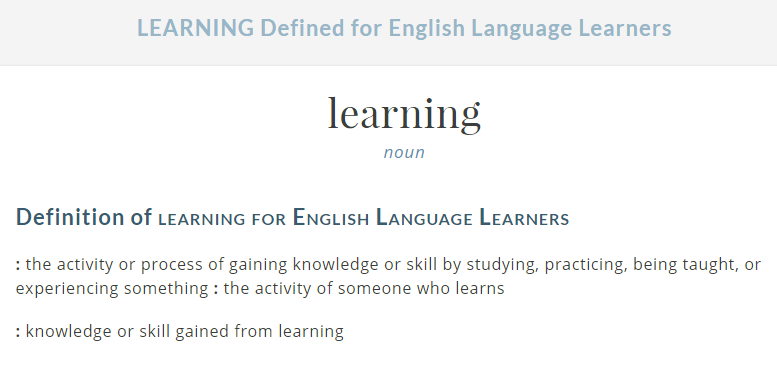
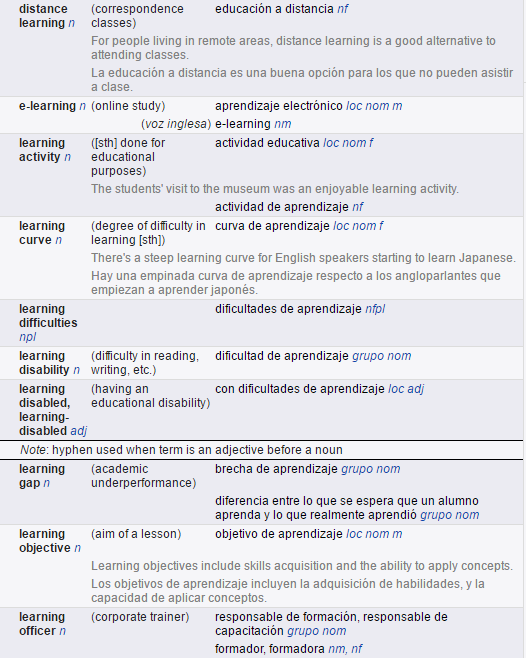
In order to do the comparison among some dictionaries (Oxford Dictionary, Webster Dictionary and WordReference), I have chosen the word 'learning':

- Oxford Dictionary:

- Webster Dictionary:


- WordReference:


Those have been the different results which I have obtained. I used to use WordReference but, now, I am disconcerted because I do not know which one I will use in the future. I think that each dictionary has its own advantages and disadvantages. On the one hand, I think Oxford Dictionary is the least complet because it only offers the basic definition, the origin and the pronunciation. Although it offers the possibility of going to other section to see some synonyms, On the other hand, I think Webster Dictionary and WordReference have a lot of information from different fields and they are more complete than Oxford Dictionary.

Looking this word up in Learner's Dictionary this is what I have found (a concrete definition with a n easy and comprehensible vocabulary):


I think I would be good to take into account all these dictionaries when teaching English and to give each of them the properly use in each case according to the necessities.

See you in the next post!


Students' Needs (1st Bac.)

Acoording to the syllabus established for 1st Bac. in the Valencian Community by the Ministry of Education, Investigation, Culture and Sports, the official requirements for the learning of English, as a subject, are the following ones:

- Comprehension of oral texts.

- Production of oral texts: expression and interaction.

- Comprehension of written texts.

- Production of written texts: expression and interaction.

- Cross curricular elements: sound, accent and intonation patterns, its relation to the communicative intentions and morphosyntactic and discursive structures.

On the other hand, the linguistic exchanges that students must use in the English class are all of them referred to the requirements mentioned above: basic narrations, little presentations, short questions and answers, some descriptions and definitions, etc. 

Students of this level must achieve at least an English level between A1-A2, although it is not always carried on, in order to be able to have a basic communication with other speakers of this language. It has to be mentioned that the main objective, in the future, is that students can achieve the B1 level of English but it is a hard work.


See you in the next post!

martes, 22 de noviembre de 2016

ICT in teaching English


Looking for a video which illustrates the importance of using ICT in the classroom of foreign languages, I have found the following one:


I really like it because it sumarizes the main characteristics of the use of ICT in this teaching: from those afraid teachers who are reticent in using them until some of the different applications which can be used. In addition, it is not too much long and the viewer can follow it because, altough the speaker speaks a little bit fast, everything is summarized in written explanations.

See you!

What is a blog?

First of all, I must say that among the given examples of blogs I like most the one called CLIL for Success, In my opinion, it has an attractive appearence what is good because this attracts people's attention. Furthermore, it is not full of long texts and it has a lot of videos to explain different topics. 

From all the sources I have checked, I must say that this one is the source where I have found the most concrete meaning: 'a personal online journal that is frequently updated and intended for general public consumption'. But it does not mean that this is the most complete. Maybe, this other source is more complete than the previous one as we can find here something more about the general 'history' about blogs. But I still do not think that this is the best one. Definitely, the one which I think best explains what is a blog is this one. This last source explains it through the definition of a blog by different sources. Then, the autor makes a little summary clarifying even more what is a blog and classifying some words related to this field. 

After having read all these sources as well as the lesson TS3, I think that the best definition of what is a blog is that one made by oneself according to everything learnt from all the different sources. In my opinion, a blog is: a way of expression, an educational tool, a personal diary (sometimes), a digital book of recommendation (about places, food, films, music...) and a long etcetera. A blog can be almost whatever you want.

See you!


Sources:
http://blogbasics.com/what-is-a-blog/
https://moodle2016-17.ua.es/moodle/pluginfile.php/17911/mod_resource/content/1/guidelines2.pdf
http://www.problogger.net/what-is-a-blog/
http://searchwindevelopment.techtarget.com/definition/blog


About me...

Good evening!

My name is Yadira and I am an English philologist although I work in a children's boutique since 2013 . I did my Bachelor's degree in the University of Almería and I finished it some years ago. Nowadays, I am finishing a Master's degree about ICT in the teaching of languages. I just have to finish my final research about the teaching of second languages through mobile devices.

I think that my level of English is better when I speak than when I write. I am used to speak in English because, where I live, the majority of the population and of the customers I have in my job are foreigner. But I am always trying to improve my English level and I do it by myself: reading English newspapers, being in touch with people who speak this language, listening to English songs... In addition, I was living for a month in England when I was 18, a month in Malta when I was 19 and a year in Denmark when I was 22. In my opinion, that was the best way to improve it.

As I have said before, I am finishing a Master's degree about ICT and I use these technologies almost every day. I am used to use my smartphone and my tablet but, sometimes, I prefer to use my e-reader if the texts which I have to read are too long.

Finally, I want to say that this is not my first online course: the Master's degree about ICT is online as well and I have already done other online courses like some MOOC.


See you!